> ## Documentation Index
> Fetch the complete documentation index at: https://docs.tilt.io/llms.txt
> Use this file to discover all available pages before exploring further.
# Onboard a client
> Create a new advisor client and account, select a model, add holdings, and check readiness.
Use onboarding when a new client needs a managed account in your advisor organization. This example creates synthetic client **Alex Rivera**. Have an authoritative client reference, account holdings, and a model portfolio available before you expect the account to be ready for optimization.
## 1. Start the new-client workflow
Ask Tilt Agent: **"Help me onboard a new client named Alex Rivera in my advisor organization. Show each proposed change before saving it."**
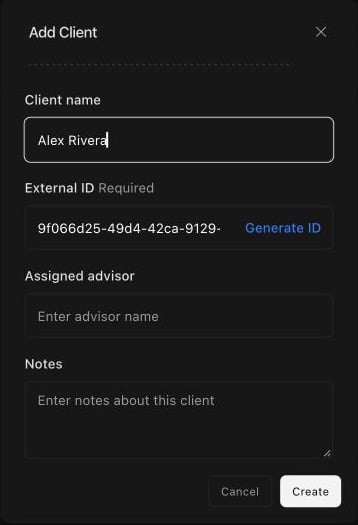
In the Tilt view, open **Clients** and select **Add Client** to inspect the new-client form. It asks for a client name and required external ID; assigned advisor and notes are optional. The screenshot shows an unsaved example.
 Tilt Agent checks Tilt for a possible duplicate identity before creation. Review the proposed client identity and confirm the creation. A new client comes with a default account; check that account in the saved result before adding source details. If the identity already exists, resolve the match rather than creating another client.
The workflow card shows the current step and the next action. A blocked step calls for missing information or a decision; it does not mean later steps were completed.
## 2. Record account context
Provide the account type and a non-sensitive provider label if you have them. In this workflow, these details form an internal account-source placeholder. They do not connect a custodian or import holdings. Do not enter credentials or connection secrets in chat.
Tilt Agent then collects a suitability brief: objective, time horizon, risk tolerance, liquidity needs, jurisdiction and tax context, and restrictions. Review the complete brief and correct it before selecting a model. The brief is workflow context, not an approved or signed investment policy statement.
## 3. Select a model and tailor the account
Ask: **"Compare the available model portfolios with Alex Rivera's confirmed brief, then show the model and account changes you propose."** Review the model's sleeves and target weights. Confirm model assignment separately from model creation or account-specific changes. A reusable model should remain shared; client restrictions and preferences belong on the account.
Read [Tailor an account](/advisor/tailor-account) for the settings and confirmation flow. If no suitable model or required sleeve exists, finish that setup before claiming the account is ready.
## 4. Add holdings and check readiness
Supply authoritative starting cash and holdings data for the exact account. Review the proposed replacement before confirming it, then ask Tilt Agent to show the saved holdings. A provider label is not evidence that positions were imported or refreshed.
Ask: **"Check Alex Rivera's account readiness and list anything still missing."** Check the saved model, account settings, holdings, and reported blockers. When the account is ready, [review a rebalance](/advisor/review-rebalance). Onboarding alone does not run an optimization or place an order.
Tilt Agent checks Tilt for a possible duplicate identity before creation. Review the proposed client identity and confirm the creation. A new client comes with a default account; check that account in the saved result before adding source details. If the identity already exists, resolve the match rather than creating another client.
The workflow card shows the current step and the next action. A blocked step calls for missing information or a decision; it does not mean later steps were completed.
## 2. Record account context
Provide the account type and a non-sensitive provider label if you have them. In this workflow, these details form an internal account-source placeholder. They do not connect a custodian or import holdings. Do not enter credentials or connection secrets in chat.
Tilt Agent then collects a suitability brief: objective, time horizon, risk tolerance, liquidity needs, jurisdiction and tax context, and restrictions. Review the complete brief and correct it before selecting a model. The brief is workflow context, not an approved or signed investment policy statement.
## 3. Select a model and tailor the account
Ask: **"Compare the available model portfolios with Alex Rivera's confirmed brief, then show the model and account changes you propose."** Review the model's sleeves and target weights. Confirm model assignment separately from model creation or account-specific changes. A reusable model should remain shared; client restrictions and preferences belong on the account.
Read [Tailor an account](/advisor/tailor-account) for the settings and confirmation flow. If no suitable model or required sleeve exists, finish that setup before claiming the account is ready.
## 4. Add holdings and check readiness
Supply authoritative starting cash and holdings data for the exact account. Review the proposed replacement before confirming it, then ask Tilt Agent to show the saved holdings. A provider label is not evidence that positions were imported or refreshed.
Ask: **"Check Alex Rivera's account readiness and list anything still missing."** Check the saved model, account settings, holdings, and reported blockers. When the account is ready, [review a rebalance](/advisor/review-rebalance). Onboarding alone does not run an optimization or place an order.