> ## Documentation Index
> Fetch the complete documentation index at: https://docs.tilt.io/llms.txt
> Use this file to discover all available pages before exploring further.
# Selection and weighting
> How the universe, filter, score, top-N limit, weights, overrides, and caps combine into a Tilt's constituents.
Tilt evaluates the construction rules in this order. Each step works on the output of the step before it.
1. Start from the eligible universe.
2. Compute derived fields.
3. Keep securities where the filter expression is true.
4. Rank the remaining securities by score, highest first. If you set a maximum, keep the top N.
5. Weight each selected security by the weight expression, or by score when the weight expression is blank. Scale the weights to sum to 100%.
6. Apply concentration caps, then rescale to 100%.
Ticker overrides adjust the result. Always-included tickers stay in the Tilt, and Tilt removes always-excluded tickers after the rules run.
## Universe
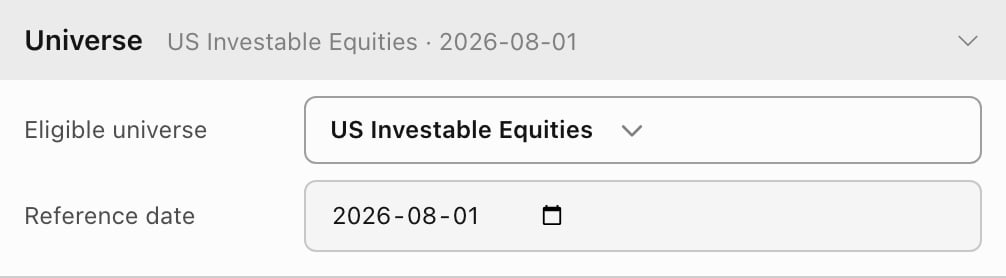
The eligible universe is the set of securities the rules evaluate, such as US Investable Equities. To build from a named index's members, keep a broad universe and add `index("") > 0` to the filter.
The reference date anchors size-segment eligibility to a point in time. Tilt then takes size segments from recorded history with buffer bands, so a company near a size boundary stays put through small price moves.
## Filter, score, and maximum constituents
The filter expression sets eligibility. A security that fails it drops out.
The score expression ranks eligible securities, highest first.
Maximum constituents keeps the top N ranked securities and requires a score expression. With no score expression, the Tilt holds every security that passes the filter.
## Position sizing
The weight expression sets position sizes for the selected securities, separate from the score that ranked them. You can pick the top 20 by quality and hold them by market cap. Leave it blank to size by score.
| Goal | Score expression | Weight expression |
| ---------------------------- | ---------------------- | ----------------------- |
| Equal weight, no ranking | blank | blank |
| Market-cap weight | Your ranking, or blank | `market_cap` |
| Free-float market-cap weight | Your ranking, or blank | `free_float_market_cap` |
| Weight by the ranking | Your ranking | blank |
| Weight by theme exposure | `theme("
 The eligible universe is the set of securities the rules evaluate, such as US Investable Equities. To build from a named index's members, keep a broad universe and add `index("
 The weight expression sets position sizes for the selected securities, separate from the score that ranked them. You can pick the top 20 by quality and hold them by market cap. Leave it blank to size by score.
| Goal | Score expression | Weight expression |
| ---------------------------- | ---------------------- | ----------------------- |
| Equal weight, no ranking | blank | blank |
| Market-cap weight | Your ranking, or blank | `market_cap` |
| Free-float market-cap weight | Your ranking, or blank | `free_float_market_cap` |
| Weight by the ranking | Your ranking | blank |
| Weight by theme exposure | `theme("
The weight expression sets position sizes for the selected securities, separate from the score that ranked them. You can pick the top 20 by quality and hold them by market cap. Leave it blank to size by score.
| Goal | Score expression | Weight expression |
| ---------------------------- | ---------------------- | ----------------------- |
| Equal weight, no ranking | blank | blank |
| Market-cap weight | Your ranking, or blank | `market_cap` |
| Free-float market-cap weight | Your ranking, or blank | `free_float_market_cap` |
| Weight by the ranking | Your ranking | blank |
| Weight by theme exposure | `theme("