Expression types
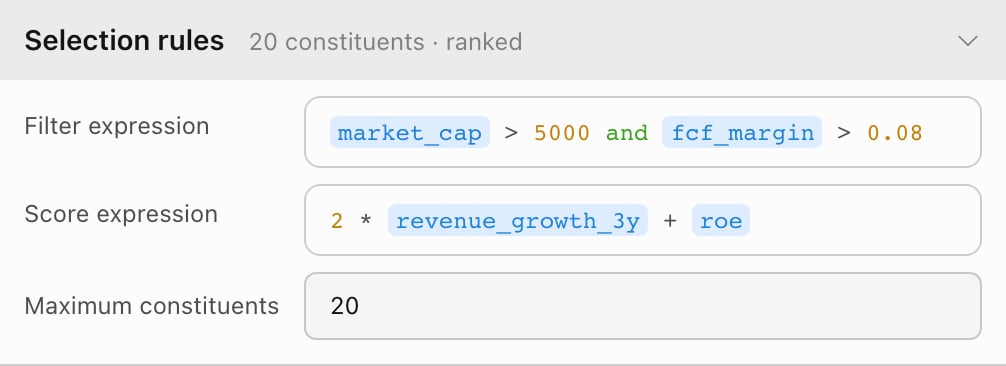
Filter and score expressions in the Selection rules section. The editor highlights field names.
Fields
A field is a named value for each security, such asmarket_cap, pe, or roe. The field catalog covers fundamentals, valuation, returns, liquidity, classification, and risk-model factor exposures. Tilt Agent can search the catalog for a field’s exact name and show its distribution.
Operators
Wrap each comparison in parentheses when you combine comparisons with
& or |.
Derived fields
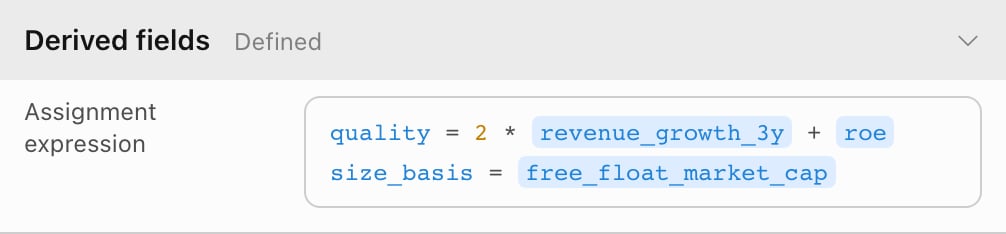
An assignment expression names a value for reuse. Write one assignment per line:quality and size_basis like any other field. Tilt evaluates derived fields first.
Functions
Membership and exposure
These functions look up a value by name. They work in filter and score expressions only. A derived field or weight expression that calls one fails.index() accepts published Tilt index names and third-party index names. A third-party name resolves to the holdings of the largest ETF that tracks the index. Universe presets are a separate setting, in the Universe section.
theme() takes a theme in plain language, such as "Nuclear Energy" or "Grid Modernization":
The score starts at 0 and has no fixed maximum. Companies with heavy exposure often score several points. Tilt’s default cutoff is 0.55, and Tilt Agent uses it unless you name another threshold. Every share class of a company gets the same score. Build a thematic Tilt walks through a Tilt built with
theme().
How theme() scores companies
Tilt matches the theme against several kinds of evidence for each company, including its SEC filings, financial news coverage, earnings calls, and analyst research. Tilt weights each source by how well it predicted relevance in testing, then combines them into one score. Every piece of evidence has a date, so a backtest sees only the evidence available on each historical date. The thematic scoring white paper documents the method, its sources, and its validation. Across 81 themes, companies it selected on held-out data averaged 8.36 out of 10 for relevance, as judged by a relevance grader that a blinded panel of portfolio managers and analysts validated. Coverage is strongest for US-listed companies, since much of the evidence comes from SEC filings and English-language financial news. A company that has changed its business keeps its old filing description until its next annual report.Trailing-window statistics
These functions summarize a field over a window that ends on the evaluation date. They work in all four expression types.
Write the field as a bare name and the window as a quoted string, such as
"3m", "1y", or "5y". Daily fields such as market_cap and pe support short windows. Quarterly fundamentals such as revenue update four times a year, so use windows of one year or more. first() accepts quarterly fundamentals only. The catalog lists the windows each field accepts.
Validation
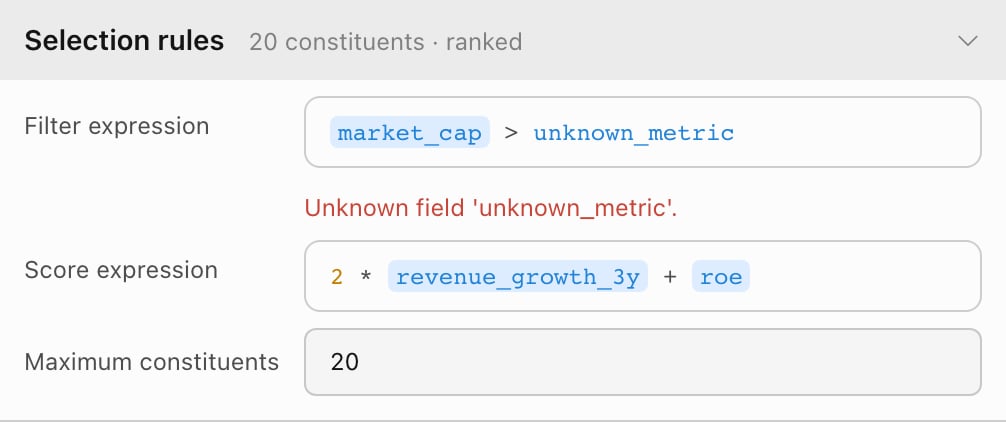
The editor checks expressions as you type. An unknown field name disables Apply changes until you fix it.