

- Start from the eligible universe.
- Compute derived fields.
- Keep securities where the filter expression is true.
- Rank the remaining securities by score, highest first. If you set a maximum, keep the top N.
- Weight each selected security by the weight expression, or by score when the weight expression is blank. Scale the weights to sum to 100%.
- Apply concentration caps, then rescale to 100%.
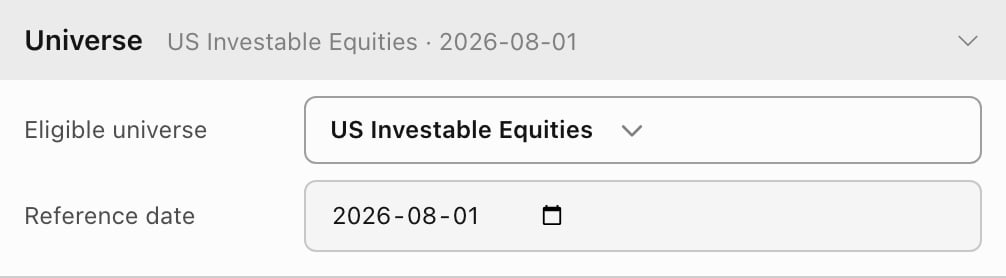
Universe
index("<name>") > 0 to the filter.
The reference date anchors size-segment eligibility to a point in time. Tilt then takes size segments from recorded history with buffer bands, so a company near a size boundary stays put through small price moves.
Filter, score, and maximum constituents
The filter expression sets eligibility. A security that fails it drops out. The score expression ranks eligible securities, highest first. Maximum constituents keeps the top N ranked securities and requires a score expression. With no score expression, the Tilt holds every security that passes the filter.Position sizing

A constant weight such as
1 gives each listing of a multi-listing company its own full position. theme() selects companies, so size a thematic Tilt by score and leave the weight expression blank. Tilt rejects a weight expression on a company-level selection when a selected company has more than one listing.
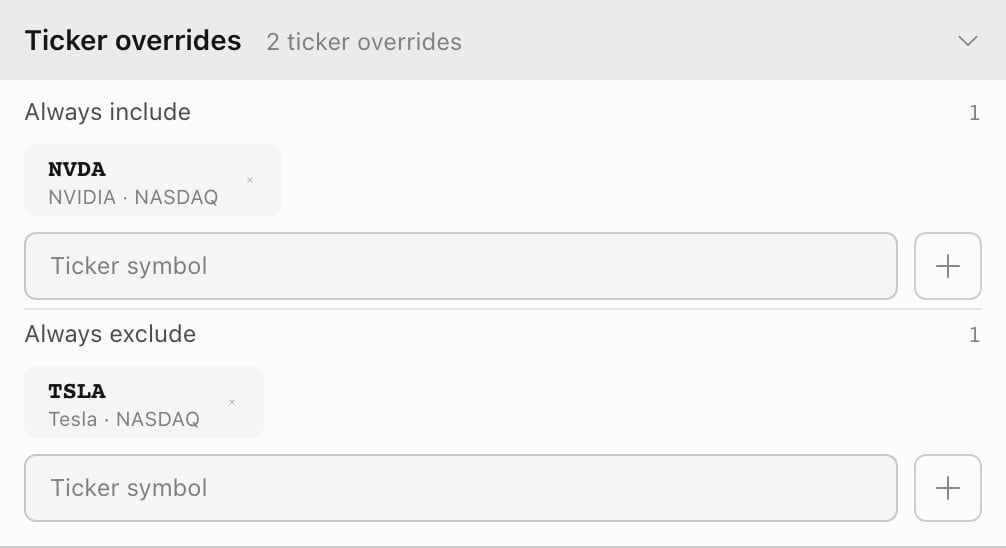
Ticker overrides
Rebalance and concentration
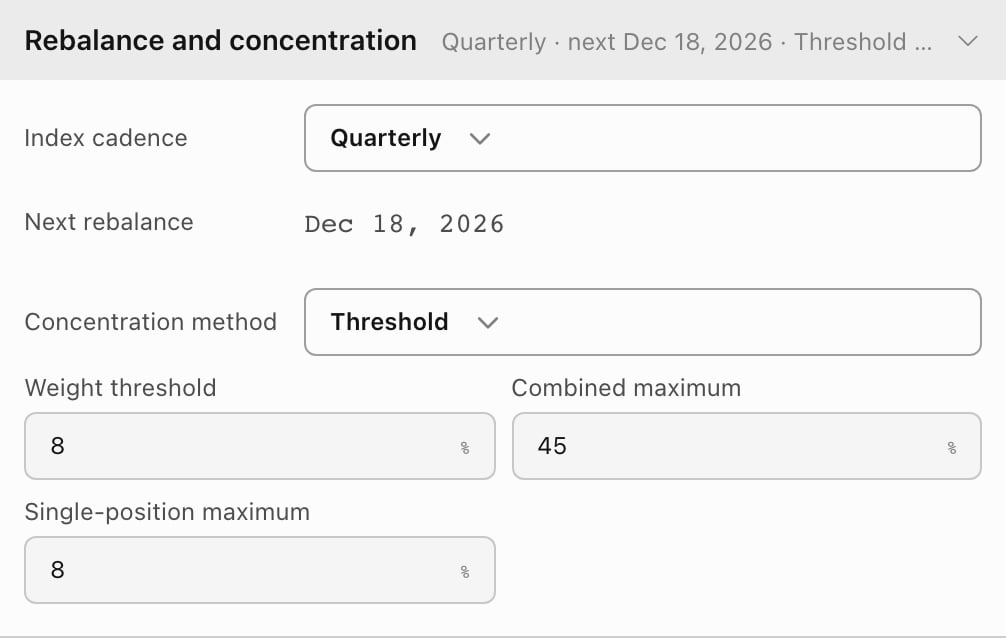
index("<name>") > 0 and you set no cadence, Tilt adopts that index’s published reconstitution schedule.
Concentration method caps position weights after selection and sizing:
Top N and Threshold also accept a single-position maximum. Leave any limit blank to turn it off. After capping, Tilt rescales the weights to sum to 100%.